Employee time tracking
Working-time records are no longer just another legal obligation for companies. In recent years they have become a particularly sensitive issue, both organisationally and legally. And that is no coincidence. The way we work has changed, hybrid models are increasingly common, and companies need real — and reliable — control over their teams' working hours.
Since Spain's Royal Decree-Law 8/2019 came into force, all companies have been required to keep a daily record of working time. That record must accurately reflect each employee's start and end times, be kept for four years, and be available for any inspection or official request.
At first glance it may look like just another administrative formality. The reality is very different.
The traditional approach — Excel sheets and manual sign-in systems — ends up generating constant incidents: missed entries, incomplete records, errors in overtime, or difficulties in actually verifying how much time has been worked.
And this is where an increasingly important aspect comes in: the validity of the time-tracking system itself.
The judgment of the Court of Justice of the European Union of 14 May 2019 (Case C-55/18, Deutsche Bank) made it clear that companies must have “objective, reliable and accessible” systems for recording working time. Since then, Spanish courts have reinforced this idea in a series of rulings.
It is no longer just about “having a system”. The system must be able to demonstrate, in a real and verifiable way, the hours actually worked by each employee.
Once that framework was set, rulings began to appear in which, when the recording system does not offer sufficient guarantees, the company is left in a difficult position in the face of employment claims. In other words, if the records are inconsistent, editable or unreliable, proving the hours actually worked becomes a problem for the company itself.
Recently, Spain's Supreme Court, in judgment 372/2026 of 15 April, once again put the focus on the importance of working-time records and on companies' responsibility for managing them properly. The ruling makes it clear that having a clocking-in system is not enough: the company must make sure the record is kept in an effective and reliable way. In the absence of valid records, or when they show inconsistencies, the company may be required to prove what hours were actually worked, especially if the employee has specified their hours precisely, as Iberley notes in its article on this judgment.
Clocking in is no longer only a regulatory obligation; it is now also a tool for legal protection, internal organisation and transparency, helping to improve team planning, detect deviations from scheduled hours, control overtime and cut a large amount of administrative work in Human Resources.
And of course, it also has a direct impact on the employee experience and on how employees perceive the company they work for. Today, employees expect to be able to clock in easily, from different devices and without complex processes. Their day-to-day life is already tied to those devices, and a dynamic, modern company does not still clock in with a slip of paper. Clocking in from a mobile device conveys a sense of security and trust, helps avoid disputes with the company and projects solidity.
In short, time tracking can no longer be understood as a simple “record of arrivals and departures”, nor as a control tool in the hands of the employer. It is a demand from both sides, employer and employee, where the reliability of the information and the traceability of the data matter more and more.
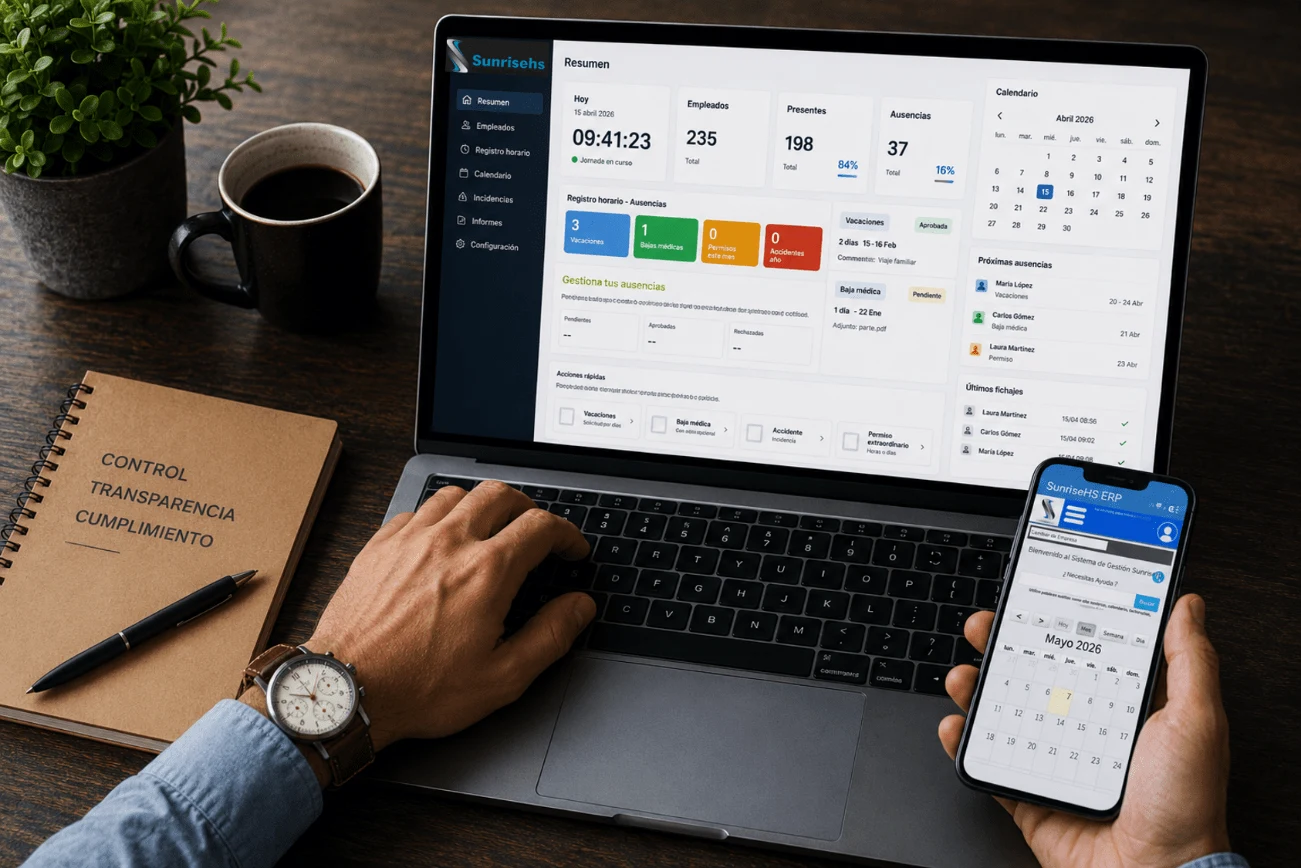
At SunriseHS ERP we help companies digitalise and automate the entire time-tracking process with an integrated, flexible solution ready for any working model, centralising all the management in a single platform.